The Birth and Evolution of Shotcrete Technology Around the World
The Birth and Evolution of Shotcrete Technology Around the World
Today, shotcrete is one of the most critical methods in modern civil engineering, but it actually began with a creative solution from a museum curator. In less than a century, this technology has evolved from a tool for museum displays into an indispensable asset for tunnels, dams, and mines worldwide.
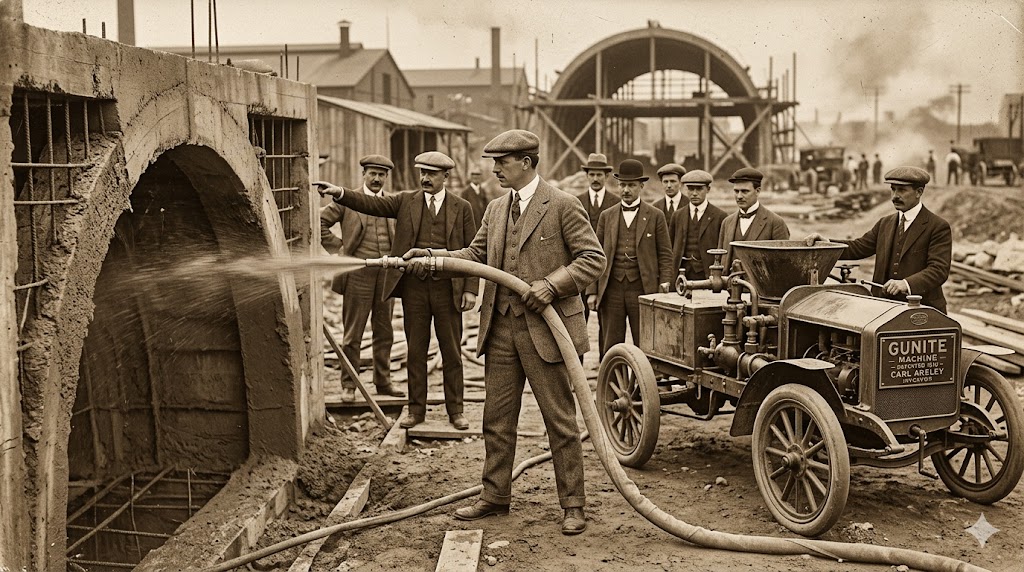
The foundation of shotcrete technology was laid in 1907 by American naturalist and curator Carl Akeley. While working at a museum in Chicago, Akeley was looking for a faster way to coat massive animal models for exhibition.
The Invention: He developed a device that used compressed air to shoot dry mortar through a hose, mixing it with water at the nozzle tip.
Branding: This method was patented in 1910 under the name "Gunite" and was initially used only for building repairs and surface coatings.
When this American-born technology reached Europe, it closed one era and opened another in tunnel engineering. Austrian engineers began using shotcrete not just as a coating material, but as a primary structural support.
NATM (New Austrian Tunnelling Method): With this method, shotcrete applied to the ground immediately after excavation became a flexible support layer that helped the ground support itself.
Impact: This development allowed for the construction of massive tunnels in mountains like the Alps, which were previously thought impossible to cross, making shotcrete the standard language of global tunneling.
Increasing global safety standards and large-scale projects caused the technology to transform once again.
Wet Mix Spraying: In the 1970s, wet system machines were developed to reduce dust formation and increase application capacity.
Health and Safety: This was a turning point for operator health, especially in confined spaces such as mines and tunnels.
Mechanization and Robotics: Manual nozzle handling has since been replaced by remote-controlled spraying robots used in massive construction sites across the globe.
Today, you can find traces of this technology in underground projects anywhere in the world. Modern shotcrete applications provide several critical advantages:
High Strength: The use of steel fiber reinforced concrete has reduced the global need for traditional iron reinforcement.
Speed: Projects that used to take years can now be completed in months thanks to shotcrete efficiency.
Accessibility: The production of world-class parts and equipment by specialized manufacturers has made this technology accessible to all countries.
Shotcrete technology was born out of a need in America, established on a scientific foundation in Europe, and has now become the key to safe construction worldwide. As part of this global heritage, we continue to carry this technology into the future with equipment produced to international standards.
Gallery