Maximum Efficiency in Shotcrete and Grouting Operations: Maintenance Guide
Maximum Efficiency in Shotcrete and Grouting Operations: Maintenance and Cleaning Guide
The success of industrial construction and mining projects is directly linked to the uninterrupted performance of the equipment used. Particularly in shotcrete (concrete spraying) and grouting (injection) operations, the maintenance discipline applied after the operation is as vital as the operating principles of the machines. In these demanding environments where concrete and chemical mixtures exhibit rapid hardening reactions, the mechanical health of every component—from refractory spraying systems to mortar mixing units—determines both your project's cost and its timeline.
In this guide, we explore professional maintenance strategies that will minimize unplanned downtime, reduce spare part costs, and maximize the lifespan of your spraying and injection systems.
Concrete residues are the primary cause of wear in concrete spraying machines. To extend the service life of the device, the following steps are critical:
Rapid Discharge: At the end of every shift, all material inside the machine must be completely emptied, and the discharging process should continue until clear water comes through the system.
Plate Precision: Steel and rubber plates should be removed, and their surfaces cleaned with a spatula or wire brush.
Lubrication Routine: To prevent friction and extend the life of the rubber, plates must be lubricated before reassembly.
Tension Adjustment: Ensure balanced tightening of the tension arms; incorrect adjustment compromises sealing and overloads the motor.
Crystallization of the grout slurry can lead to a complete system lockup. To manage this risk:
Rotor-Stator Protection: The rotor and stator must be separated and cleaned at the end of the operation.
Hardening Prevention: The entire line, from the mixer tank to the nozzle tip, must be flushed with water so that no material remains.
Pre-Assembly Preparation: After cleaning, parts should be lubricated before reinstallation; this reduces metal fatigue and frictional resistance.
The abrasive and fast-setting nature of refractory materials requires special attention:
Nozzle Inspection: Spraying nozzles must be checked frequently to ensure a homogeneous flow of material and to prevent blockages.
Airway Cleaning: The air inlets and outlets of the system should be purged periodically to prevent obstructions.
Wear Monitoring: Due to the hard nature of the refractory, hoses and transmission components should be inspected regularly.
Quality mortar begins with a clean tank and healthy mixing paddles:
Internal Tank Purging: Hardened mortar layers on the internal surfaces of the tank increase the rotation resistance of the mixer, leading to gearbox failures.
Paddle Geometry: Hardened residues on the mixing paddles must be cleaned to prevent the motor from overheating.
Homogeneity Control: A clean mixer unit ensures the mortar reaches the ideal consistency faster, offering energy savings.
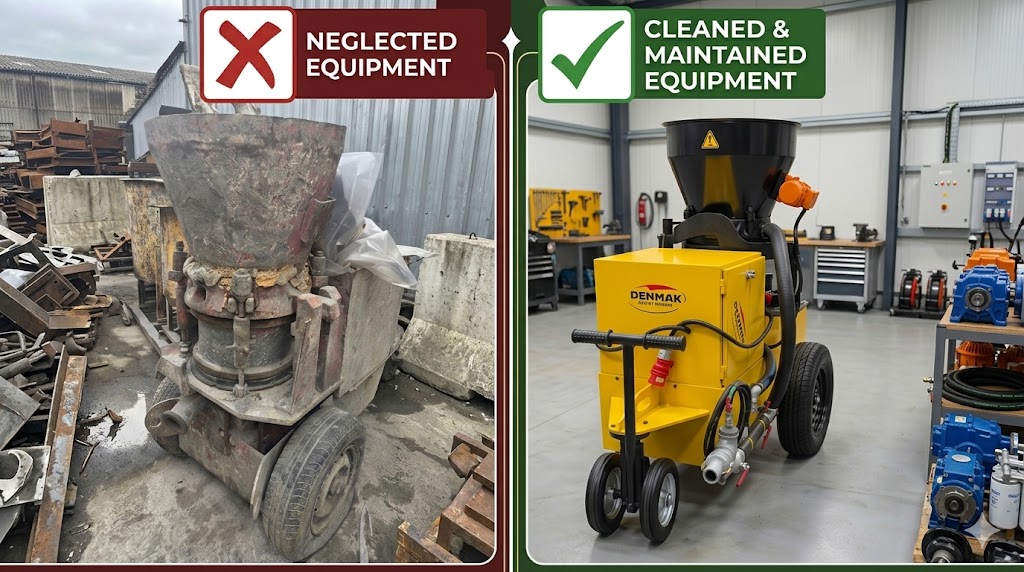
Periodic technical service checks should not be neglected to ensure your machines continue to operate at high performance. It should be noted that failure to follow the cleaning and maintenance routines specified in the manuals is the most fundamental user error that results in machines being excluded from warranty coverage. To avoid encountering the "user error" clause when a malfunction occurs, regular documentation and maintenance are mandatory.
Gallery