Concrete Admixtures and Dosing: The Effect of Set Accelerators on Compressive Strength
Concrete Admixtures and Dosing: The Effect of Set Accelerators on Compressive Strength
Shotcrete — also known as sprayed concrete — is a critical technique used in some of construction's most demanding scenarios: tunnel support, slope stabilization, underground mining, and structural reinforcement. In these applications, concrete must be propelled through a nozzle under compressed air and adhere to overhead and vertical surfaces without slumping, flowing, or falling away.
The chemical agent that wins this battle against gravity is the set accelerator admixture. A properly selected and correctly dosed accelerator enhances worker safety, accelerates project timelines, and ensures structural integrity. Improper use, however, can significantly undermine the concrete's 28-day compressive strength — with lasting structural consequences.
In this article, we examine the chemical mechanism of set accelerators, the critical differences between alkali and alkali-free types, dosing principles, and why a precision dosing pump is an indispensable part of any reliable shotcrete system.
Set accelerators are water-soluble organic or inorganic salts that trigger the chemical reaction (hydration) between cement and water in a very short time. Sodium silicate, sodium aluminate, aluminium sulphate, and calcium formate are among the most widely used compounds in this class.
At the chemical level, accelerators speed up the hydration of tricalcium silicate (C₃S) and tricalcium aluminate (C₃A) in the cement. This rapidly generates large quantities of calcium silicate hydrate (C-S-H) and ettringite (AFt) crystals. As ettringite forms a compact network between clinker particles, the concrete achieves set in a very short time.
In practical field terms, set accelerators deliver three core advantages:
• Flash set: With rapid-set accelerators, initial set can occur within 60–90 seconds and final set within 120–180 seconds. The concrete bonds to the surface the moment it leaves the nozzle and does not sag.
• Early strength gain: The concrete develops load-bearing capacity within the first few hours after application, allowing tunnel support systems to be brought into service quickly.
• Rebound reduction: Strong adhesion to the substrate minimises material loss due to rebound, delivering both cost savings and environmental benefits.
The most critical distinction in the classification of set accelerators is between alkali-bearing (ALK) and alkali-free (AKF) types. The field behaviour and long-term effects on compressive strength of these two types differ significantly.
Alkali-Bearing (Conventional) Accelerators
Traditional alkali accelerators based on sodium silicate and sodium aluminate have been in use since the 1960s. Typical dosage is 3–6% by mass of the binder. While they offer rapid set, they carry several critical drawbacks:
• High pH levels (pH > 12) pose a serious hazard to workers' skin and eyes.
• 28-day final compressive strength drops measurably compared to control samples. Domestic and international research demonstrates this loss can range from 15% to 30%.
• Increased porosity is a common outcome, weakening the concrete's long-term resistance to water ingress and chemical attack.
Alkali-Free (Aluminium Sulphate-Based) Accelerators
Alkali-free accelerators, based on aluminium sulphate solution, began to emerge in the 1980s and have since become the most widely preferred accelerator type worldwide. Typical dosage is 4–8% by mass of the binder.
Independent research reports a significantly more favourable effect on concrete strength. Scientific literature shows that when alkali-free accelerators are used at optimum dosage, the loss in 28-day compressive strength is as low as approximately 3%, while flexural strength can actually increase by around 10% compared to control samples. This finding indicates that alkali-free accelerators support both early and final strength development.
• Low pH (3–8): Far safer for workers; skin and eye irritation risk is minimal.
• Lower strength loss: A clear advantage for long-term structural reliability.
• Reduced rebound: Improved surface adhesion increases material efficiency.
• More environmentally friendly: No alkali waste; easier site and waste management.
• Cost balance: Although unit cost is higher than alkali accelerators, the overall mix cost is comparable since less cement is typically required.
In conclusion: for modern shotcrete applications — particularly long-service tunnel and infrastructure projects — alkali-free accelerators are the recommended standard from both a technical and occupational health perspective.
The dosage of set accelerators is always calculated as a percentage of the binder (cement) mass in the concrete mix — never relative to water or total aggregate weight. General industry ranges are as follows:
1. Alkali accelerators: 3–6% of binder mass (typical range)
2. Alkali-free accelerators: 4–8% of binder mass (typical range)
The key factors that determine optimum dosage include: ambient temperature and humidity, cement type and dosage, orientation of the application surface (horizontal, vertical, or overhead), the water/cement ratio of the mix, and the early-strength targets set for the project.
Risks of Underdosing
When the accelerator rate is set too low, set time is prolonged and concrete begins to sag away from the surface before it can hold. On overhead applications in particular, this creates serious safety hazards, and increased rebound leads to significant material waste.
Risks of Overdosing
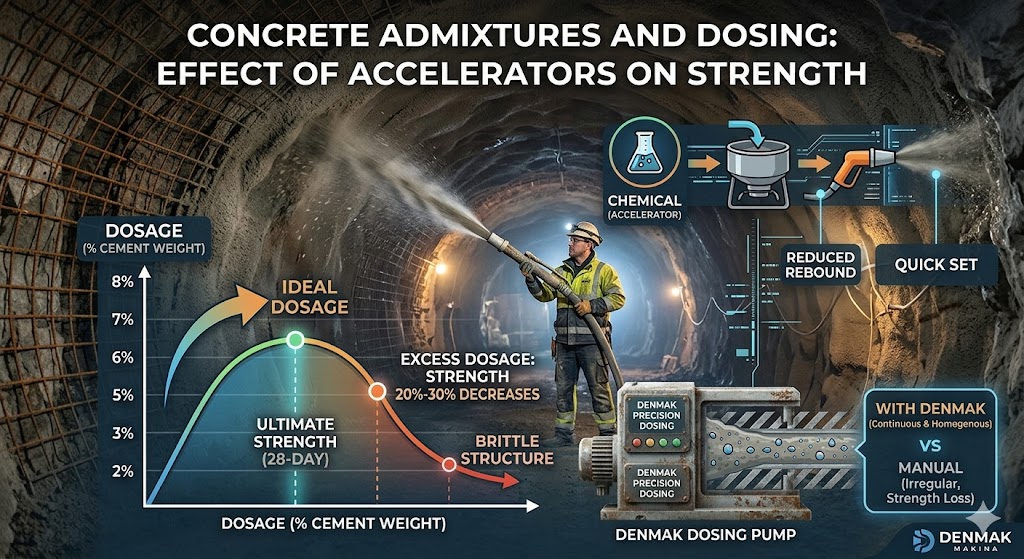
Pushing the dosage too high creates an entirely different set of problems. With alkali accelerators, excess dosage disrupts the C-S-H gel structure and increases porosity, potentially reducing 28-day compressive strength by 20–30%. In structures such as tunnels that carry long-term loads, this is a serious structural weakness.
Even with alkali-free types, overdosing is harmful: ettringite may concentrate unevenly rather than distributing homogeneously, increasing the risk of micro-cracking. For this reason, trial mixes should always be performed for each project to establish the optimum dosage before full-scale application.
Set accelerators are not used in all concrete applications; they are indispensable specifically in the following scenarios:
Tunnel Excavation and Support
In tunnel excavation, the newly exposed face must be supported as rapidly as possible. Accelerator-dosed shotcrete reaches sufficient early strength within the first few hours to activate the support system against rock and ground movement. This is critical for both worker safety and tunnel stability.
Slope and Embankment Stabilisation
Shotcrete applied to inclined surfaces and embankments must not flow downward before it sets. Set accelerators ensure the concrete holds its position against gravity in these applications.
Underground Mining
Sprayed concrete used for overhead and sidewall support in mine galleries is exposed to frequently changing temperature and humidity conditions underground, requiring careful selection of accelerator type and dosage.
Surfaces with Active Water Ingress
High-dosage accelerators with very rapid set can also be used to plug active water leaks. In these applications, initial set may occur within 1–4 minutes and final set within 3–10 minutes.
Cold Weather Conditions
At low ambient temperatures, cement hydration slows significantly. Set accelerators compensate for this by allowing the concrete to develop adequate strength before being exposed to the risk of frost damage.
To properly understand the effect of set accelerators on concrete strength, two separate time windows must be evaluated together:
5.1. Early Strength (First 24–48 Hours)
During this phase, the effect of set accelerators is clearly positive. Compared to unaccelerated control mixes, accelerated shotcrete can increase 1-day compressive strength by between 20% and 84%. This range varies depending on the accelerator type and dosage, cement type, and ambient temperature.
In tunnel applications, this is critically important: international standards — such as China National Railway Group QCR 807-2020 — require shotcrete to reach 1 MPa compressive strength within 6–8 hours of application. Modern alkali-free accelerators comfortably exceed this threshold.
5.2. Final Strength (28-Day)
Over the long term, accelerator type is the decisive factor:
• Alkali accelerators: Due to disruption of the C-S-H gel structure and elevated porosity, 28-day compressive strength may fall 15–30% below the control sample. This loss is a significant liability for both structural safety and the long-term durability of the concrete.
• Alkali-free accelerators: Scientific research shows that when alkali-free accelerators are used at optimum dosage, compressive strength loss is limited to approximately 3%, while flexural strength can increase by around 10% compared to control samples.
These data clearly demonstrate that accelerator selection in modern shotcrete projects should not be driven solely by early set requirements, but must be aligned with long-term structural performance targets.
All the chemical calculations and material selections described above only deliver results when the accelerator is applied in exactly the right quantity and distributed homogeneously throughout the mix. Under site conditions, manually measuring and adding accelerators to the mix is vulnerable to human error and to variations caused by ambient conditions. The cost of such deviations is paid either as concrete that fails to set properly, or as a structurally weakened end product.
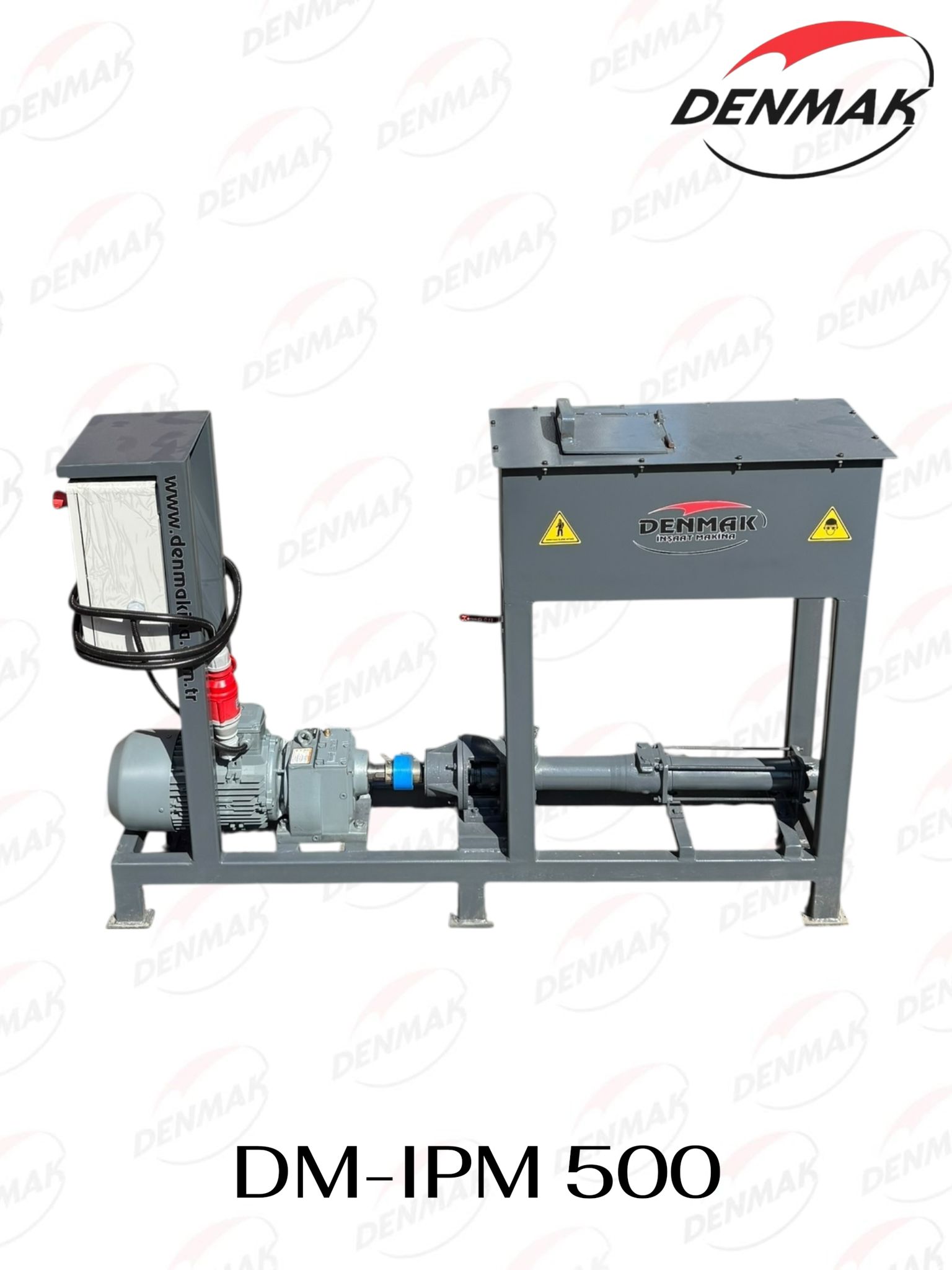
The precision dosing pumps integrated into Denmak Makina's shotcrete machines are specifically designed to eliminate this risk. The dosing pump operates in synchronisation with the concrete flow rate, injecting the accelerator into the system at a constant, pre-set ratio at all times.
Technical Advantages of the Denmak Dosing Pump
• Homogeneous distribution: The same ratio of accelerator is present in every cubic centimetre of the mix, from start to finish. This homogeneity — virtually impossible to achieve manually — is the fundamental prerequisite for consistent strength development throughout the structure.
• Flow rate synchronisation: If the shotcrete machine speeds up or slows down, the dosing pump responds instantly. Maintaining a constant ratio is especially critical during long tunnel drives.
• Cost efficiency: Excessive accelerator consumption is prevented. Reducing unnecessary chemical usage delivers direct cost savings while minimising the negative impact on final compressive strength.
• Recording and traceability: On pumps integrated with digital control systems, the applied dosage can be logged. This feature is a significant asset on large infrastructure projects that require quality documentation.
• Worker safety: When working with alkali accelerators, the pump eliminates the risk of direct manual contact; even with alkali-free types, it reduces chemical exposure to a minimum.
In short, the dosing pump is not merely a convenience tool — it is a strategic piece of equipment that directly determines the technical success of any shotcrete application.
The table below summarises the key differences between alkali and alkali-free accelerators:
Property Alkali (ALK) Alkali-Free (AKF)
Typical dosage 3–6% (of binder) 4–8% (of binder)
pH value > 12 (highly alkaline) 3–8 (safe range)
28-day strength loss 15–30% ≤ 3%
Worker safety Low–moderate High
Environmental impact High alkali waste Low
Unit cost Lower Higher
Total mix cost Comparable (less cement needed) Comparable
The set accelerator admixture can be considered the heart of any shotcrete application. When selected correctly and applied at the right dosage, it enhances worker safety while simultaneously meeting both schedule and structural quality targets.
In modern shotcrete projects, alkali-free accelerators are increasingly the preferred choice, offering low long-term strength loss and a superior occupational safety profile. That said, no accelerator can compensate for poor dosing practice.
This is precisely where Denmak Makina's precision dosing pumps make the difference. Operating in synchronisation with concrete flow, these systems guarantee homogeneous mixing, consistent strength development, and optimised chemical consumption — elevating shotcrete application from a craft to an engineering standard.
Gallery